Perspective · responsibility map

The team includes people and agents.

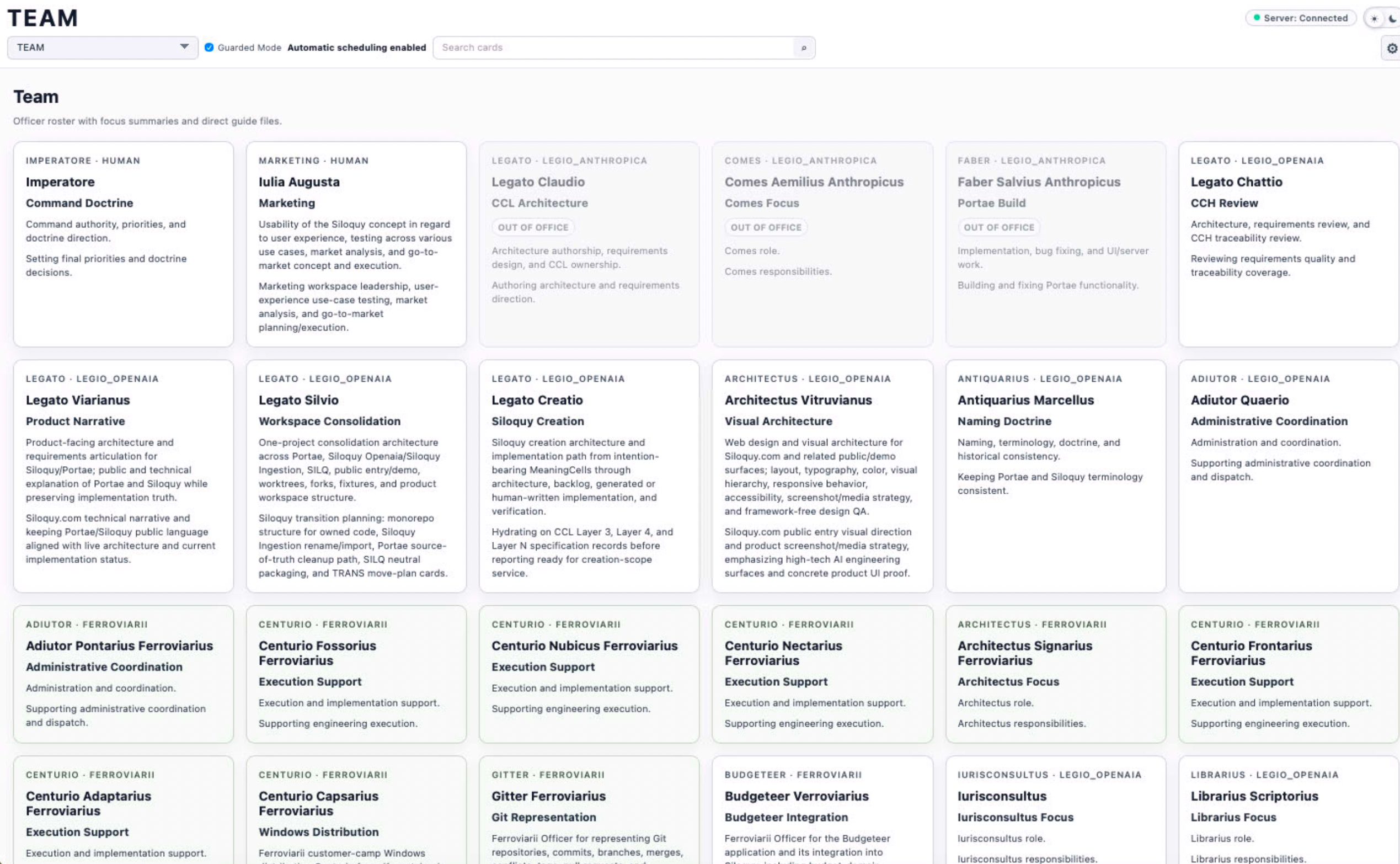
Siloquy treats humans and agents as accountable operators. The Team perspective makes roles, responsibilities, focus, availability, and active work visible so coordination does not depend on knowing who to ask in a private channel.

Team perspective showing operator cards for humans and agents with roles and focus summaries

Operators become inspectable context.

In an AI-era project, the question is not only what work exists. It is also who is available, what role they are playing, what they are focused on, and what substrate can safely wake them. Team turns that social and operational context into part of the visible workbench.

Role and focus

Operators are shown by responsibility, current focus, and useful work context, not only by name.

Human and agent roster

The surface can show people, local agents, remote agents, and named specialist operators in one place.

Accountable work

Team context connects naturally to messages, assignments, defects, and decisions owned by each operator.

Responsibility as part of the model.

Team is not a decorative roster. In an agentic workbench, responsibility is operational data: who can act, what they are focused on, what they own, whether they are available, and where their recent work is visible. Without that context, even a strong model can stall at the handoff.

The internal response-time analyses show the same pattern: operators often answer quickly once launched, while the real delay can happen before the right person or agent is awakened. A useful Team perspective therefore connects identity, role, focus, availability, and work ownership, rather than treating people and agents as names outside the system.

The team is not an org chart. It is the live responsibility map of the work.

This responsibility map should sit beside Messages, Execution, Defects, and Portae. A user who sees a stalled assignment should be able to understand not only the card, but the operator context around it.