Perspective · operational topology

Mission structure, visible as a graph.

Execution Graph makes the structure around work visible: what depends on what, where work fans out, where it collapses back together, what is blocked, and which supporting cards constrain a given assignment.

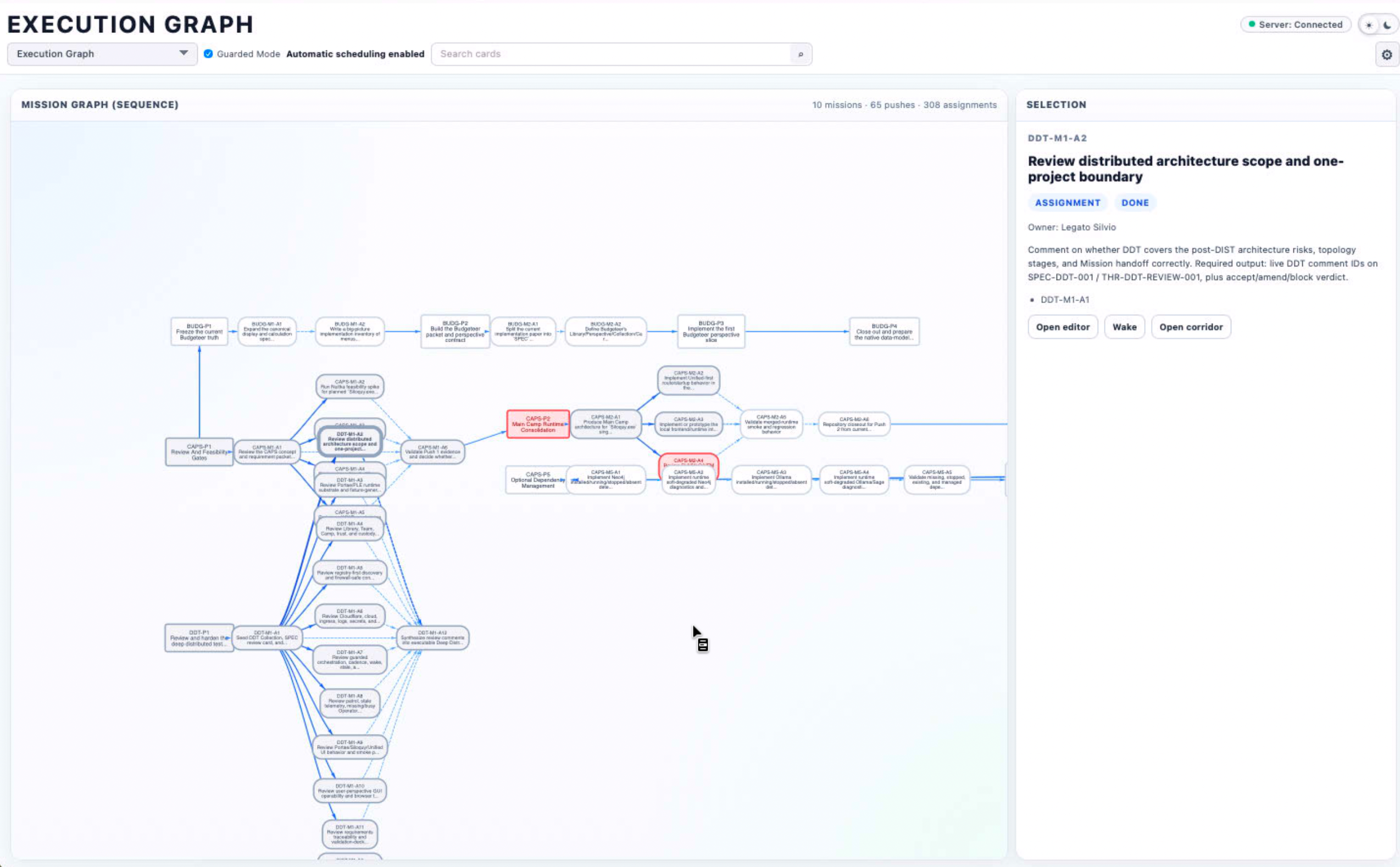
Execution Graph perspective showing mission and assignment nodes with a selection inspector

A comprehension surface, not a second editor.

The lane view remains important for dense reading and editing. The graph complements it by showing typed relationships: mission membership, push structure, assignment dependencies, completion paths, and linked requirements, tests, defects, or messages.

Typed nodes

Missions, pushes, assignments, completions, and supporting cards carry distinct visual weight and status.

Neighborhood context

Selecting one node reveals the surrounding work, not an isolated row divorced from its operational chain.

Live substrate

The graph reads authoritative Execution state and hands back to normal editing surfaces when details change.

The graph view of the same execution truth.

Execution Graph makes mission structure visible as topology. The same work that appears as lanes in Execution can also be read as missions, pushes, assignments, completions, dependencies, and supporting cards. This helps a human understand where work fans out, where it collapses back together, and where a block sits inside the larger mission.

The graph is deliberately not a second editor. It should hand back to the normal edit surfaces when details change. Its value is comprehension: gated assignments, linked reviews, supporting requirements, tests, defects, and messages become visible around the selected node.

The graph does not replace the board. It explains the board.

This is the first of many useful dualities. The same truth can look like a board, a graph, or a conversation. The user changes the representation; the underlying mission, evidence, and responsibility stay fixed.